Electricity is an essential part of modern life, powering everything from household appliances to industrial machinery. To ensure the safe and efficient distribution of electrical power, every electrical system consists of three important conductors: Phase (Live), Neutral, and Earth (Ground). Each conductor performs a unique function that helps electrical circuits operate correctly while protecting people and equipment from electrical hazards.
What Are Phase, Neutral, and Earth?
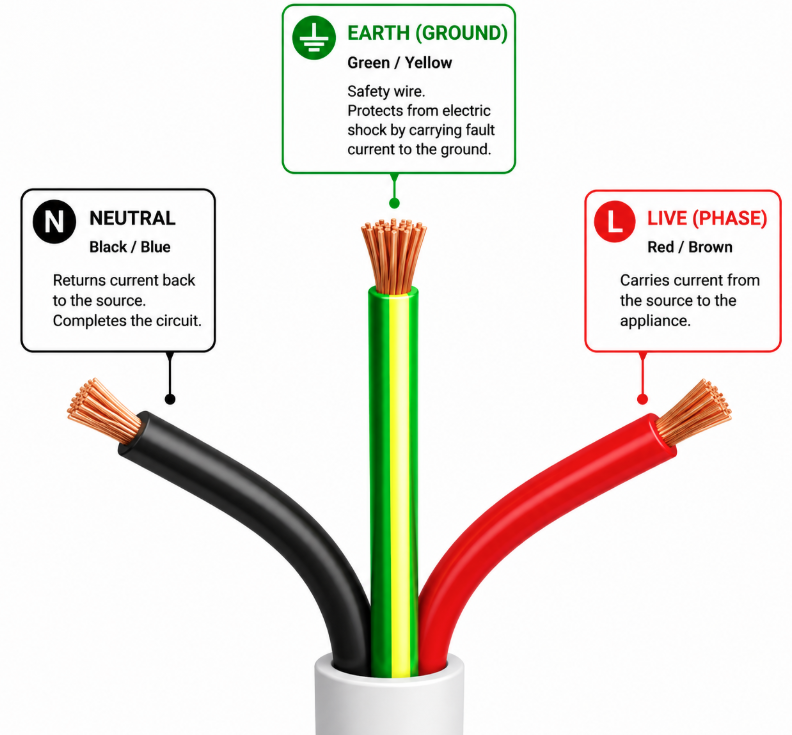
An electrical power supply typically consists of three conductors:
- Phase (Live): Carries electrical power from the source to the electrical load.
- Neutral: Provides the return path for current back to the power source, completing the circuit.
- Earth (Ground): Provides a safe path for fault current to flow into the ground, protecting users from electric shock.
Together, these conductors ensure that electricity is delivered safely, efficiently, and reliably.
1. Phase (Live) Wire
The phase wire, also called the live wire, is the conductor that carries electrical voltage from the power supply to electrical devices. Since it is energized, touching the phase wire can result in a dangerous electric shock.
Functions of the Phase Wire
- Delivers electrical energy to appliances and equipment.
- Supplies voltage to complete the electrical circuit.
- Works with the neutral wire to allow current flow.
Typical Characteristics
- Carries the full supply voltage (e.g., 230 V in many countries).
- Color coding varies by country but is commonly Brown, Red, or Black.
- Always treated as a live conductor.
2. Neutral Wire
The neutral wire carries the electrical current back to the source after it has passed through the electrical load. It completes the circuit and enables continuous current flow.
Although the neutral wire is connected to ground at the main electrical panel, it should never be considered completely safe to touch because it may still carry current under normal operating conditions.
Functions of the Neutral Wire
- Completes the electrical circuit.
- Returns current to the transformer or power source.
- Helps maintain stable voltage levels in the electrical system.
Typical Characteristics
- Normally close to 0 volts relative to earth.
- Commonly identified by the color Blue (IEC standard).
- Carries load current during normal operation.
3. Earth (Ground) Wire
The earth wire, also known as the ground wire, is a safety conductor. Under normal conditions, it does not carry electrical current. Instead, it provides a low-resistance path for fault current if an electrical fault occurs.
If the metal body of an appliance becomes energized due to insulation failure, the earth wire directs the fault current safely into the ground. This allows protective devices such as circuit breakers or residual current devices (RCDs) to disconnect the power quickly, reducing the risk of electric shock and fire.
Functions of the Earth Wire
- Protects people from electric shock.
- Provides a safe path for fault current.
- Helps circuit breakers and protective devices operate during faults.
- Protects electrical equipment from damage.
Typical Characteristics
- Does not normally carry current.
- Connected directly to the grounding system.
- Commonly identified by Green/Yellow insulation.
How Phase, Neutral, and Earth Work Together
When an electrical appliance is switched on:
- The phase wire delivers electrical energy from the power source to the appliance.
- The appliance uses the electrical energy to perform work, such as producing light, heat, or motion.
- The neutral wire returns the current back to the power source, completing the circuit.
- Under normal conditions, the earth wire carries no current. If a fault occurs, it safely diverts fault current to the ground, allowing protective devices to disconnect the supply.
Color Codes (IEC Standard)
| Conductor | Function | Common Color |
|---|---|---|
| Phase (Live) | Supplies electrical power | Red / Brown |
| Neutral | Returns current to source | Black / Blue |
| Earth (Ground) | Safety and fault protection | Green/Yellow |
Note: Wire color codes may vary depending on local electrical standards and regulations.
Importance of Proper Earthing
Proper earthing is one of the most important safety measures in any electrical installation. An effective earthing system:
- Reduces the risk of electric shock.
- Protects electrical equipment from damage.
- Prevents electrical fires caused by fault currents.
- Ensures protective devices operate correctly.
- Improves the overall safety and reliability of the electrical system.
Safety Tips
To ensure safe operation of electrical systems:
- Never touch exposed live (phase) wires.
- Ensure all electrical installations are properly grounded.
- Use circuit breakers and RCDs for additional protection.
- Do not remove or disconnect the earth wire from electrical equipment.
- Have electrical installations inspected regularly by qualified electricians.
Leave a Reply