The OCR3000 is a modern DCS controller module used in the Ovation system for monitoring and controlling industrial processes. It is widely used in:
- Power generation plants
- Water and wastewater treatment systems
- Large-scale industrial automation
The controller performs real-time control by processing field signals and executing control logic.
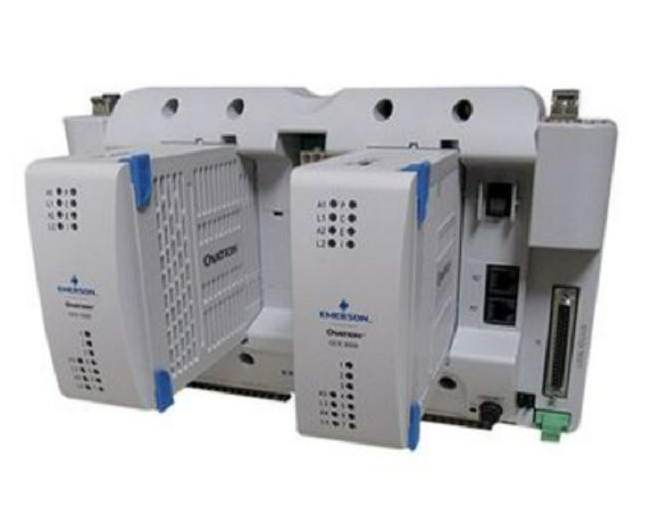
One of the key advancements of the OCR3000 is its integrated architecture.
The controller combines:
- Processor
- I/O Interface (IOIC)
into a single module, simplifying system design and improving performance.
The OCR3000 provides a highly scalable I/O structure:
- Supports up to 16 I/O branches
- Each branch supports up to 8 I/O modules
This results in a total capacity of:
16 × 8 = 128 I/O modules per controller
The controller scans all I/O branches in parallel, significantly improving response time compared to earlier models.
Evolution from OCR1100
The OCR3000 is the successor to the OCR1100 controller. While maintaining compatibility with existing Ovation I/O modules and applications, it introduces:
- Higher processing performance
- Improved system integration
- Faster I/O scanning
Key Technical Features
Processor and Performance
- System-on-Chip: Zynq UltraScale+ MPSoC
- Quad-core ARM Cortex-A53 processor
- Operating frequency: 1.2 GHz
- Supports up to 64,000 process points
- Up to 5 control tasks, each configurable
Control Execution
- Loop execution time: 10 ms to 300 seconds
Memory and Storage
- 1 GB LPDDR4 SDRAM with ECC
- 32 MB QSPI Flash (expandable)
- USB storage support
Communication and Networking
- Ethernet ports:
- 4 × RJ45 (copper) OR
- 2 × RJ45 + 2 × SFP (fiber)
- Supports 10/100/1000 Mbps
Network Terminals and Connectivity
The OCR3000 controller includes multiple network terminals used for different communication purposes:
- N1 Terminal
Used for communication with third-party systems (such as external SCADA, OPC, or other control systems) - N2 and N3 Terminals
Used for communication within the Ovation control network
These connect the controller to Ovation servers, workstations, and other system nodes - N4 Terminal
Used for controller redundancy communication
Redundancy Example
In a redundant controller pair:
- Controller 1 = Primary
- Controller 51 = Secondary (Backup)
The N4 terminal connects Controller 1 to Controller 51, enabling:
- High-speed synchronization
- Automatic takeover in case of failure
This ensures continuous operation without interruption.
Redundancy and Reliability
The OCR3000 is designed for high-availability systems and supports:
- Controller redundancy (primary and backup)
- Network redundancy
- Redundant 24V power supply
These features ensure reliable operation in critical industrial environments.
Cabinet and Installation Flexibility
Ovation systems provide flexible cabinet configurations:
- Basic controller cabinet with local I/O branches
- Expansion cabinets for additional I/O modules
Features include:
- DIN rail mounting
- Front and rear access
- Flexible cable entry options
Typical Applications
The OCR3000 controller is used in:
- Thermal and hydro power plants
- Water and wastewater treatment plants
- Industrial automation systems
It is designed for applications where continuous operation is essential.
Leave a Reply