Electric motors are the driving force behind countless industrial and commercial applications, from pumps and compressors to conveyor systems and manufacturing machines. While small motors can operate on a single-phase power supply, most industrial motors use a three-phase power supply because it provides greater efficiency, smoother operation, and higher performance.
In this article, we’ll explore why three-phase power is the preferred choice for motors and the advantages it offers over single-phase power.
What Is Three-Phase Power?
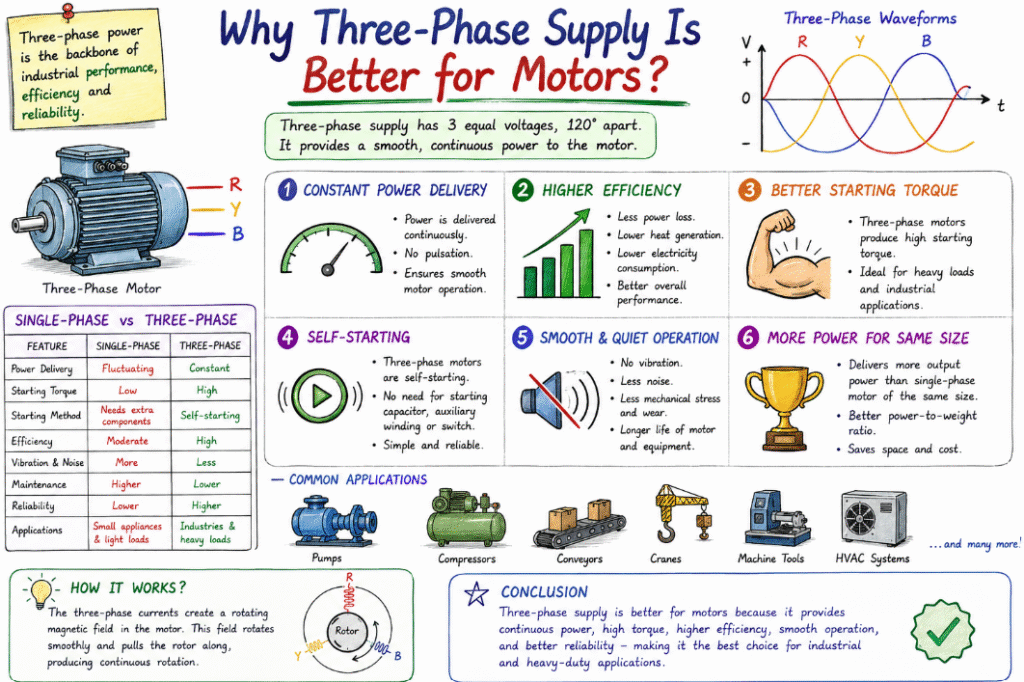
A three-phase power supply consists of three alternating current (AC) voltage waveforms that are equal in magnitude and frequency but are separated by 120 degrees from one another.
Because the three waveforms are evenly spaced, the total power delivered to the motor remains nearly constant throughout the electrical cycle. This continuous power flow is the main reason why three-phase motors perform better than single-phase motors.
Why Is Three-Phase Supply Better for Motors?
1. Continuous Power Delivery
One of the biggest advantages of three-phase power is its ability to provide continuous and balanced power.
In a single-phase system, the power rises and falls during each cycle, causing fluctuations. In contrast, a three-phase supply ensures that at least one phase is delivering power at any given moment.
Benefits:
- Smooth motor operation
- Reduced vibration
- Consistent performance
2. Self-Starting Capability
Three-phase motors produce a naturally rotating magnetic field, allowing them to start automatically without additional components.
Single-phase motors often require:
- Starting capacitors
- Start windings
- Centrifugal switches
Since three-phase motors eliminate these extra parts, they are simpler, more reliable, and require less maintenance.
3. Higher Starting Torque
Three-phase motors generate significantly higher starting torque than single-phase motors.
This makes them ideal for:
- Pumps
- Compressors
- Cranes
- Elevators
- Conveyor belts
- Heavy industrial machines
High starting torque allows motors to start heavy loads quickly and efficiently.
4. Greater Efficiency
Three-phase motors convert electrical energy into mechanical energy more efficiently.
Advantages include:
- Lower power losses
- Reduced heat generation
- Lower electricity consumption
- Better overall performance
Higher efficiency also results in lower operating costs over the motor’s lifetime.
5. Smooth and Quiet Operation
Because power delivery remains nearly constant, three-phase motors operate with minimal vibration and noise.
Benefits include:
- Reduced mechanical stress
- Less wear on bearings
- Improved machine accuracy
- Longer equipment lifespan
This smooth operation is especially important in industrial automation and precision machinery.
6. Higher Power Output
For the same physical size, a three-phase motor can deliver more power than a single-phase motor.
This means:
- Smaller motor size for the same output
- Better power-to-weight ratio
- More compact machine designs
7. Improved Reliability
Three-phase motors have a simpler internal construction because they do not require starting components such as capacitors.
As a result, they offer:
- Longer service life
- Lower maintenance costs
- Increased reliability
- Fewer breakdowns
This makes them ideal for continuous industrial operation.
8. Better Load Handling
Industrial equipment often experiences changing or heavy loads.
Three-phase motors maintain stable speed and performance even when load conditions vary, making them suitable for demanding applications.
Comparison: Single-Phase vs. Three-Phase Motors
| Feature | Single-Phase Motor | Three-Phase Motor |
|---|
| Starting Method | Requires starting mechanism | Self-starting |
| Starting Torque | Low | High |
| Efficiency | Moderate | High |
| Power Delivery | Pulsating | Continuous |
| Vibration | More | Less |
| Maintenance | Higher | Lower |
| Power Output | Lower | Higher |
| Industrial Use | Limited | Widely used |
Common Applications of Three-Phase Motors
Three-phase motors are commonly used in:
- Industrial machinery
- Water pumps
- Air compressors
- Conveyor systems
- HVAC equipment
- Elevators and escalators
- Manufacturing plants
- Mining equipment
- Agricultural irrigation systems
- Large refrigeration systems
Leave a Reply