As renewable energy systems become more common, electrical power systems are becoming more flexible and decentralized. Solar photovoltaic (PV) systems, battery energy storage, and microgrids are increasingly being connected to three-phase electrical networks.
Three-phase supply is particularly useful for larger solar and energy-storage installations because it can distribute power efficiently across multiple loads while supporting reliable operation of commercial, industrial, and community-scale systems.
What Is a Three-Phase Supply?
A three-phase electrical supply uses three AC voltage waveforms that have the same frequency and magnitude but are separated from one another by 120°.
This arrangement provides a smoother and more balanced flow of electrical power than a single-phase system.
For solar and battery systems, power electronics called inverters convert DC electricity into AC electricity suitable for connection to the three-phase network.
Three-Phase Solar Power Systems
Solar panels generate DC electricity. A solar inverter converts this DC power into AC power.
In a three-phase solar installation, the inverter distributes the generated AC power across the three phases.
A simplified energy flow is:
Solar Panels → DC Power → Three-Phase Inverter → AC Power → Building / Grid
During sunny conditions, solar energy can supply local loads. If generation exceeds demand, the excess electricity may be exported to the grid, depending on the system design and local regulations.
Three-Phase Battery Energy Storage
Battery storage systems store electrical energy as DC power. A bidirectional inverter allows the battery to both charge and discharge.
The basic process is:
Grid/Solar → Inverter → Battery → Inverter → Three-Phase Loads
During periods of high solar production, excess energy can be stored in the battery. Later, when solar generation falls, the battery can discharge through the inverter to supply electrical loads.
This can help:
- Reduce peak demand
- Increase solar self-consumption
- Provide backup power
- Improve energy management
- Support grid stability
Why Three-Phase Is Useful for Battery Storage
Large battery systems often need to supply significant amounts of power. Three-phase distribution makes it easier to deliver this power to commercial and industrial loads.
For example, a battery energy storage system may supply:
- Motors
- Pumps
- HVAC equipment
- Refrigeration systems
- Industrial machinery
- Data-center equipment
- Commercial lighting and electrical loads
Because the load is distributed across three phases, the system can operate more efficiently and maintain better electrical balance.
Three-Phase Supply in Microgrids
A microgrid is a local electrical network that can contain several energy resources and loads. It may operate connected to the utility grid or, when properly designed, operate independently during an outage.
A typical renewable-energy microgrid may include:
Solar PV + Battery Storage + Grid + Generator + Electrical Loads
The three-phase system acts as the electrical backbone connecting these different components.
Example
During the day:
Solar → Loads + Battery Charging
During the evening:
Battery → Loads
During a grid outage:
Solar + Battery → Critical Loads
When renewable generation and battery capacity are insufficient, another source such as a generator or the utility grid can provide additional power.
Advantages of Three-Phase Supply for Microgrids
1. Better Load Distribution
Electrical loads can be distributed across the three phases to reduce imbalance and improve system performance.
2. Suitable for High-Power Loads
Three-phase systems are well suited to large motors, pumps, compressors, HVAC systems, and industrial equipment.
3. Efficient Power Distribution
Three-phase distribution can deliver substantial power efficiently while keeping conductor requirements reasonable compared with equivalent single-phase arrangements.
4. Better Integration of Renewable Energy
Three-phase inverters allow solar PV and battery systems to interact effectively with three-phase buildings and utility networks.
5. Flexible Energy Management
A microgrid controller can coordinate solar generation, battery charging/discharging, grid imports and exports, and other power sources according to system requirements.
Solar + Battery + Microgrid: How They Work Together
A simplified system looks like this:
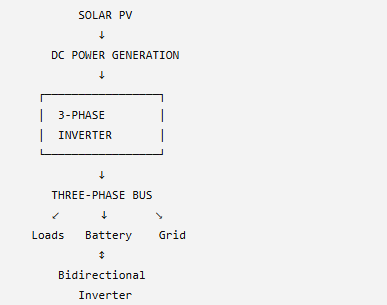
The energy management system (EMS) or microgrid controller coordinates these components so that energy is used efficiently.
Important Considerations
Designing a three-phase renewable-energy system requires more than simply selecting an inverter. Engineers must consider:
- System voltage and frequency
- Solar array capacity
- Battery capacity and power rating
- Inverter rating
- Three-phase load balance
- Protection and isolation
- Earthing and electrical safety
- Grid-interconnection requirements
- Backup and islanding requirements
- Power-quality requirements
For grid-connected systems, appropriate protection and control equipment is particularly important because the inverter must operate correctly with the utility network.
Leave a Reply